

Nobody tells you that the first week of feeding a newborn feels nothing like the pictures. The pictures show a calm baby nursing peacefully. The reality is a baby who eats twelve times a day, at completely irregular hours, taking amounts so small you cannot believe they are enough - while your milk has not fully come in and everyone around you asks whether the baby is eating okay.
Here is the strange comfort in the actual clinical numbers: almost everything about that picture is the system working exactly as designed. This article walks through days one to seven - what is normal, what the honest checkpoints are, and the short list of things that genuinely warrant a call. For the longer arc, our breastfeeding timeline covers the months ahead, and how a lactation consultant can help explains the fastest way to get skilled eyes on a problem.
How Often Newborns Actually Eat
At least 8 to 12 times per 24 hours. That figure is consistent across the CDC, the American Academy of Pediatrics, and ACOG - and it means feeding every one to three hours, timed from the start of one feed to the start of the next, around the clock.
Two things follow from that. First, "did the baby just eat an hour ago?" is not evidence something is wrong. Second, in week one your job is not to build a schedule - it is to feed the baby whenever the baby asks. The rhythm comes later.
Cluster feeding is a feature, not a fault
Some stretches - usually evenings - your baby may want to nurse every 30 to 60 minutes for hours. The USDA's WIC breastfeeding program says it plainly: this is called cluster feeding, it is normal, and it does not mean your baby is not getting enough milk. It may simply be your baby's way of filling up before a longer sleep.
Cluster feeding is the single most common reason new parents conclude their supply has failed in week one. It is also one of the ways a newborn tells your body to make more milk. Feeding through it is the correct response.
Two caveats from our clinical team, so the reassurance never outruns safety: cluster feeding is normal when diaper output is on track and nursing is pain- and damage-free. Pain, nipple damage, or low diaper output is a reason for an evaluation, not endurance. And an evening marathon is not proof of low supply - evening milk runs naturally lower in volume but higher in fat (one reason it may help your baby sleep longer), and supply does not vanish at one hour of the day. When you are worried, look back over the whole past 24 hours rather than judging by the hardest stretch.
Sources: CDC, "How Much and How Often to Breastfeed" · AAP/HealthyChildren, "How to Tell if Your Breastfed Baby is Getting Enough Milk" · ACOG, "Breastfeeding Your Baby" · USDA WIC, "Cluster Feeding and Growth Spurts."
The Amounts Are Tiny - On Purpose
In the first 24 hours, a healthy full-term newborn takes roughly 2 to 10 milliliters of colostrum per feed. That is between half a teaspoon and two teaspoons. By day four, it is still only 30 to 60 mL - a shot glass, give or take.
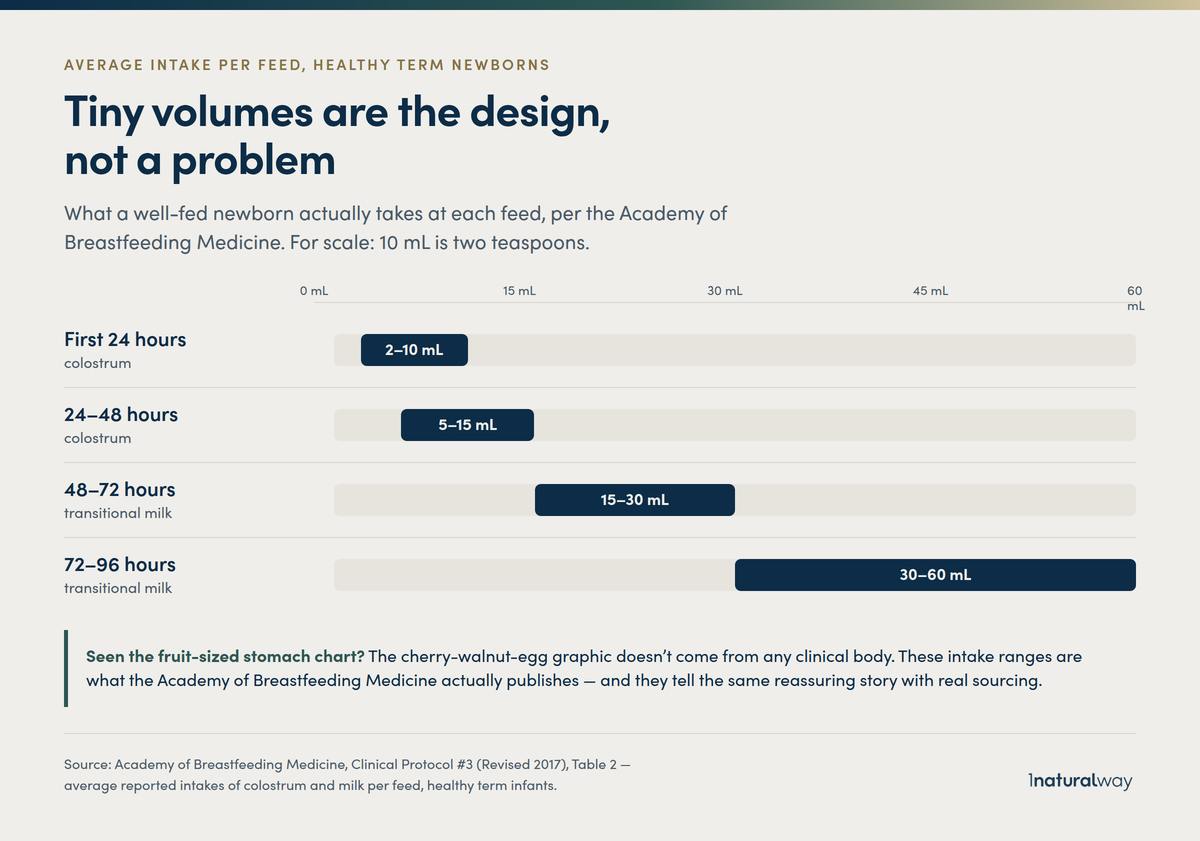
You may have seen the famous graphic comparing a newborn's stomach to a cherry, then a walnut, then an egg. Here is something we found while fact-checking this article: that image does not come from any clinical body - not the AAP, not the CDC, not the Academy of Breastfeeding Medicine - and the researchers who have examined it found its data traces to studies from the early 1900s. What the ABM actually publishes is the intake table above, which makes the same reassuring point with real sourcing: tiny volumes in the first days are the design, not a shortfall.
This is also why colostrum is worth trusting. WIC calls it "liquid gold" for a reason - it is dense in nutrients and antibodies, delivered in exactly the small volumes a brand-new stomach handles well. One more perspective IBCLCs like to share: the bottles hospitals use for supplementing hold two ounces - a full feed for a four-or-five-day-old. A brand-new baby given that much stretches their stomach, and mom's perfectly normal colostrum volumes can suddenly seem like not enough. They are enough.
Sources: ABM Clinical Protocol #3 (Revised 2017), Table 2 · Spangler et al., J Hum Lact 2008 (critique of stomach-size models) · USDA WIC, "The Phases of Breast Milk."
When Milk "Comes In" - and How Often It Comes In Late
Milk typically transitions from colostrum to higher volumes between 24 and 72 hours after birth, with transitional milk continuing to change for up to two weeks. And if yours takes longer: in a landmark U.S. study, 44% of first-time mothers experienced milk onset later than 72 hours. Across 35 studies and more than 19,000 women, the pooled figure is 30%.
In other words, "my milk was late" describes something between a third and nearly half of new mothers. It is a reason to keep feeds frequent and watch output closely - and, if it passes day five, a reason to call. It is not a verdict.
Sources: Nommsen-Rivers et al., Am J Clin Nutr 2010 (44%, first-time mothers) · Peng et al., Int Breastfeed J 2024 (30% pooled) · USDA WIC, "The Phases of Breast Milk" (transitional milk 2–5 days to 2 weeks).
Clinical Insight from Joanna Kreyling, NP, IBCLC: "The week-one visits I remember are rarely about a real supply problem. Most often they are about a mom doing everything right - or one who needs a minor latch adjustment - but has no way to know it - because nobody showed her what normal looks like. Feeding twelve times a day, a baby who wants to be held constantly, milk on day four: that is a normal chart. What I want parents to memorize is not reassurance, it is the checkpoints - diapers, weight, and the red flags. Those tell you the truth either way."
Weight Loss That Is Normal - and the Line That Is Not
Newborns lose weight in the first days - on average around 5.5% of birth weight for breastfed babies, and the AAP's benchmark is that loss should not exceed 8 to 10%. Babies born by cesarean tend to lose more, and take longer to regain.
Two details worth knowing exactly. First, the Academy of Breastfeeding Medicine is explicit that 10% weight loss is not an automatic trigger for formula - it is a trigger for an evaluation, where feeding gets observed and a plan gets made - ideally by someone trained to assess latch and milk transfer. Improving a latch, even one that does not hurt, helps the breast empty better and can end supplementation sooner. Second, regaining birth weight usually happens by about two weeks, and almost always by three.
If supplementation is medically indicated, the volumes are small - measured in teaspoons, not bottles - and your own expressed milk is the first choice. A bridge, not a surrender.
Sources: ABM Clinical Protocol #3 (2017) - 5.5% mean, "not an automatic marker" · AAP/HealthyChildren - 8–10% threshold, regain by ~2 weeks, almost all by 3 · Flaherman et al., Pediatrics 2015 (cesarean trajectories).
The Honest Scoreboard: Diapers
You cannot see how much milk goes in at the breast. You can count what comes out - which is why every pediatrician starts with diapers.

The pattern to expect: wet diapers climb roughly one per day of life - one or more on day one, two or more on day two - reaching six or more per day from about day five, with pale, nearly colorless urine. Stools start as black, tarry meconium, turn greenish by days three and four, and settle into yellow, loose, seedy stools at least three to four times a day by the end of the week. That color change is direct evidence your milk is arriving and moving through your baby. Volume is a signal too: wet diapers should also get noticeably heavier day by day as your milk increases.
Sources: AAP/HealthyChildren, "How to Tell if Your Breastfed Baby is Getting Enough Milk" · La Leche League International, "Signs Baby Isn't Getting Enough Breastmilk" · USDA WIC, "Is My Baby Eating Enough?"
Sleep, Cues, and the Rhythm of a Normal Day
Sleep: a lot, in small pieces
Newborns typically sleep about 16 to 17 hours a day - in stretches of one to three hours, waking to eat. There is deliberately no official recommendation for infants under four months, because normal variation is too wide to pin a number on. If your baby's pattern looks nothing like your friend's baby's pattern, that is the expected outcome, not a problem.
Sources: Johns Hopkins Medicine, "Newborn Sleep Patterns" · Stanford Medicine Children's Health · AASM pediatric consensus (no recommendation under 4 months).
Hunger cues: catch the early ones
Babies signal hunger long before they cry. Early cues: stirring, turning the head to root, bringing fists to the mouth. Active cues: lip smacking, sucking on hands, opening and closing the mouth. Crying is a late sign - and a crying baby latches worse, which is why catching the earlier cues makes feeds calmer for both of you.
Sources: USDA WIC, "Baby's Hunger Cues" · ACOG, "Breastfeeding Your Baby."
The Red Flags - Specific, Short, and Worth Memorizing
Call your pediatrician the same day - or seek urgent care - for any of these:
- Fever: a rectal temperature of 100.4°F (38°C) or higher in a baby under 3 months is an immediate call, per the AAP.
- Too few diapers: fewer wet diapers than the day-by-day pattern above, dark urine after day 5, or no stool progression past black by day 5.
- Deepening jaundice: skin turning more yellow - especially the belly, arms, or legs - yellow whites of the eyes, or a jaundiced baby who is hard to wake or feeding poorly.
- Lethargy: a baby too sleepy to feed, regularly sleeping four or more hours at a stretch in week one, or missing feeds.
- Poor feeding: a baby who is not able to feed, or cannot keep feeds down (vomiting).
And call a lactation consultant - without waiting for the pediatrician visit - if feeding hurts beyond the first latch, if your milk has not come in by day 5, if your breasts are so engorged your baby cannot latch, or if you cannot hear swallowing during feeds. The AAP's own advice ends with a line we would frame on the wall: don't stop asking for one-on-one guidance until you get the help you need.
Many plans cover lactation consultations, and virtual visits mean help can happen from your couch in week one. If pumping becomes part of your plan - for engorgement, supply, or a bridge - our guide on how much milk to expect when pumping sets honest expectations for the early days.
Sources: AAP/HealthyChildren - "Fever and Your Baby," "Jaundice in Newborns," "Warning Signs of Breastfeeding Problems" · LLLI, "Signs Baby Isn't Getting Enough Breastmilk."
One Thing to Do Before the Baby Comes
If you are reading this while still pregnant: order your breast pump now. Under the Affordable Care Act, most plans are required to cover one, and having it in the closet before delivery means engorgement at 2am on day four is an inconvenience, not a crisis. Submit your insurance information and we'll review your coverage - and our hospital bag checklist covers the rest of the before-baby prep. While you are at it, consider a prenatal breastfeeding class: walking into week one already knowing the basics makes everything above far less mysterious.
Check what your insurance covers
Frequently Asked Questions
How often should a newborn eat in the first week?
At least 8 to 12 times per 24 hours - roughly every one to three hours, timed from the start of one feeding to the start of the next. This figure is consistent across the CDC, the American Academy of Pediatrics, and ACOG. Feeding on demand, rather than on a schedule, is the goal in week one.
Is cluster feeding normal?
Yes. Stretches where a baby wants to nurse every 30 to 60 minutes - often in the evening - are called cluster feeding, and the USDA WIC program notes this is normal and does not mean your baby is not getting enough milk. It is also one of the ways your baby signals your body to increase supply.
How much colostrum does a newborn actually need?
Far less than most parents expect. Per the Academy of Breastfeeding Medicine, healthy term newborns average 2 to 10 mL per feed in the first 24 hours - half a teaspoon to two teaspoons - rising to 30 to 60 mL per feed by day four. Tiny volumes in the first days are normal, not a shortfall.
When does milk come in - and what if mine is late?
Usually between 24 and 72 hours after birth. Later than 72 hours is common: it happened to 44% of first-time mothers in a landmark U.S. study, and to about 30% of mothers overall across pooled studies. Keep feeds frequent, watch diaper output closely, and call your provider or a lactation consultant if your milk has not come in by day 5.
How much weight loss is normal for a newborn?
Breastfed newborns lose on average about 5.5% of birth weight, and the AAP's benchmark is that loss should not exceed 8 to 10%. Even at 10%, the Academy of Breastfeeding Medicine is explicit that this is a trigger for an evaluation, not an automatic switch to formula. Most babies regain birth weight by about two weeks.
How many wet diapers should a newborn have?
Roughly one or more on day one, climbing about one per day, to six or more wet diapers a day from day five onward, with pale urine. Stools should progress from black meconium to greenish by days three and four, to yellow and seedy - at least three to four a day - by days five to seven. Fewer than that is a same-day call to your pediatrician.
How much do newborns sleep in the first week?
Typically about 16 to 17 hours per day, in short stretches of one to three hours. There is deliberately no official recommendation for infants under four months because normal variation is so wide - so a baby who sleeps differently from the averages is not automatically a concern.
Is a breast pump covered by insurance?
Under the Affordable Care Act, most health plans are required to cover a breast pump. Coverage varies by plan - some pumps are covered in full, while premium models may involve an out-of-pocket upgrade cost. Submit your insurance information and we'll review your coverage. For plan-specific benefit limitations and restrictions, contact your insurance for details.
You Are Doing Better Than It Feels Like
Week one is the steepest part of the whole curve - for your baby's body, and for yours. If the feeds are frequent, the diapers are tracking, and the red flags are absent, then what you are experiencing is not chaos. It is the design.
And if you need a pump, supplies, or a lactation consultant in your corner, we can check what your plan covers - or call (888) 977-2229 and talk to a real person (we answer Monday–Friday, 8:30am–5pm ET).