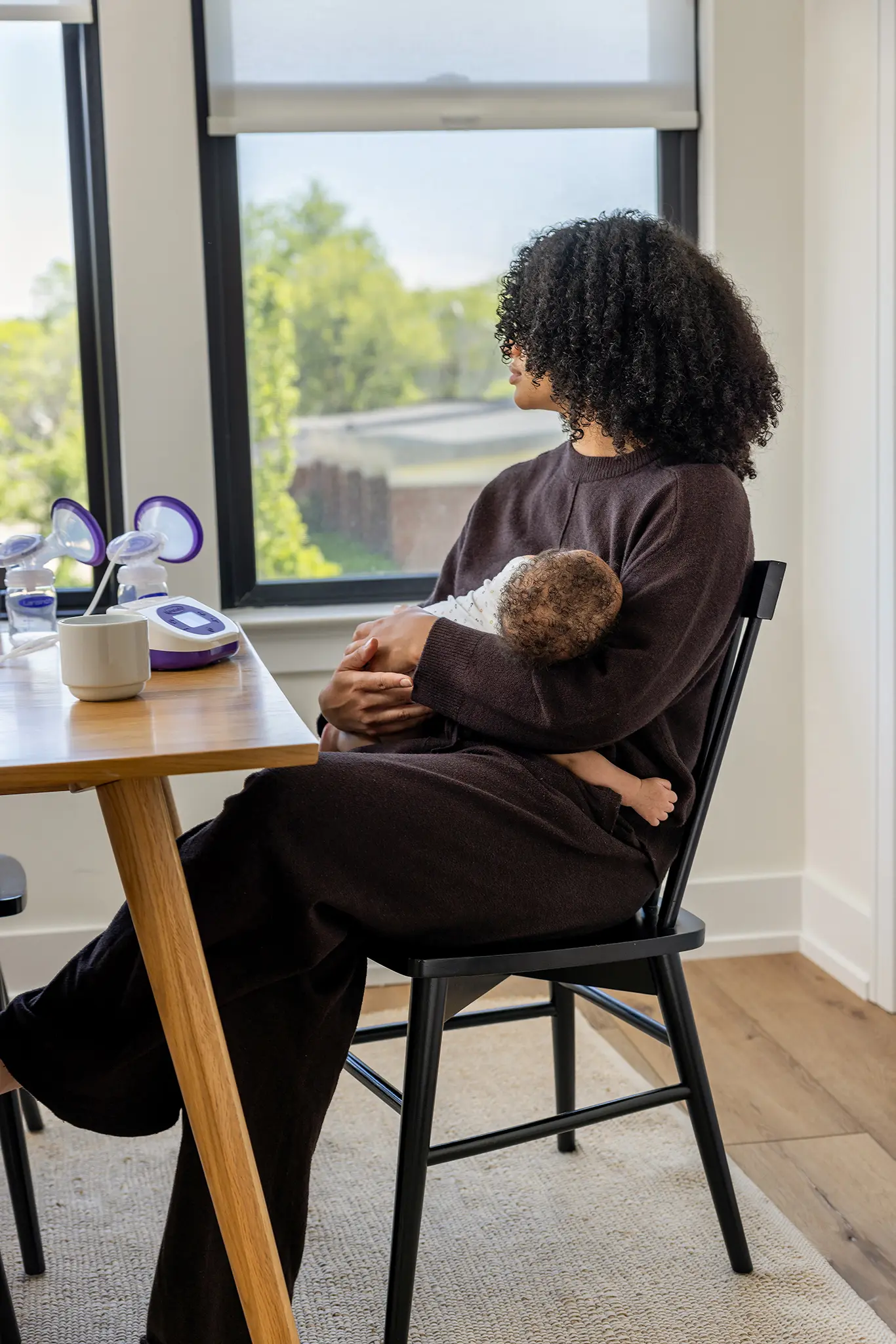
An at-home blood pressure cuff built for pregnancy and the postpartum weeks that matter most.
Hypertensive disorders — preeclampsia, gestational hypertension, and postpartum hypertension — are among the leading causes of pregnancy-related death in the U.S. An automatic upper-arm cuff at home lets you track blood pressure between OB visits, share readings with your care team, and catch warning signs early. Most major insurance plans cover the monitor when your provider documents a qualifying indication.
Whether you have chronic hypertension going into pregnancy, you're being watched for preeclampsia, or you've just been discharged after delivery, an at-home BP monitor turns a once-every-few-weeks number into a daily picture. We handle the prescription paperwork and insurance verification so the cuff arrives ready to use.
Prescription required. Our care team coordinates the Rx
with your provider — no chasing paperwork.
Why moms choose it
What sets Blood Pressure Cuff
apart.
Automatic upper-arm cuff
A one-button, fully automatic upper-arm monitor — the form factor the American Heart Association recommends for accurate home measurement. No stethoscope, no manual inflation, no guesswork. Wrap the cuff, press start, and the device handles inflation, measurement, and display.
Clinically validated accuracy
Validated to the AAMI/ESH/ISO 81060-2 universal standard for blood pressure measuring devices, the protocol recognized by the American Heart Association. That means the device has been tested against a reference standard with a mean difference of no more than 5 mmHg — the bar a monitor must clear before it can be recommended for clinical or self-measurement use.
Irregular heartbeat detection
The monitor flags irregular heartbeat patterns detected during a reading. This is especially relevant in pregnancy and the postpartum period, when arrhythmias and palpitations are more common and can be an early signal worth raising with your provider.
Memory for multiple readings
Stores 60+ time-stamped readings per user so you can show your OB or midwife a trend, not a single number. Trends matter — providers don't act on one isolated reading; they look at patterns over days and weeks. Two-user memory means a partner can track on the same device.
Blood pressure and pulse on one screen
Large, backlit display shows systolic, diastolic, and pulse together in oversized digits. Easy to read at 6 a.m. in a dim nursery, with a newborn in one arm, on three hours of sleep — which is exactly when many postpartum readings actually happen.
True one-button operation
Cuff on, button down, reading in under a minute. No app required for a basic reading, no menus to navigate, no setup ritual. The fewer steps between you and a number, the more likely you'll actually monitor on the schedule your provider recommends.
Cuff sized for pregnancy and postpartum bodies
Standard adult cuff fits arm circumferences from roughly 8.7" to 16.5" — the range most pregnant and postpartum patients fall into, including the fluid shifts and weight changes of the third trimester and the first six weeks after delivery. The wrong cuff size is one of the most common causes of inaccurate home readings.
Bluetooth app sync (on supported models)
Pair with a free companion app to log readings automatically, chart trends, and export a PDF to bring or send to your OB, midwife, or MFM. Useful when your care team asks you to "send over your last two weeks" — no transcribing from the monitor screen.
The details
Specs & specifications.
Type
Automatic upper-arm digital (oscillometric)
Cuff size
Standard or Extra Large
Measurement range
Pressure 0–299 mmHg; pulse 40–199 bpm
Accuracy
Pressure ±3 mmHg; pulse ±5%
Validation
AAMI/ESH/ISO 81060-2 standards
Memory
60+ readings × 2 user profiles
Power
4 AA batteries (incl.); AC adapter compatible
Rx required
Yes — for insurance coverage
How it works
How to get your Blood Pressure Cuff order.
1
Tell Us About Your Plan
Enter your insurance details and due date. It takes about two minutes - we'll verify your coverage instantly, no phone calls required.
2
We Coordinate the Prescription
Most maternity-support items require a quick prescription from your provider. Our care team handles the outreach so you don't have to chase paperwork.
3
We Ship It to Your Door
Once your order is approved, we ship directly to you - free. Most moms receive their order within 3-5 business days.
U.S. pregnancies complicated by preeclampsia. Hypertensive disorders are documented in 31.6% of delivery hospitalizations involving maternal death (CDC).
Insurance coverage
Most major plans cover an at-home BP monitor with a qualifying Rx.
Most major U.S. health plans cover an at-home blood pressure monitor as durable medical equipment when your provider documents a qualifying indication during pregnancy or the postpartum period. Under the ACA, monitoring devices tied to preventive maternal care and chronic-condition management are commonly covered with little or no out-of-pocket cost.
Aetna
Blue Cross Blue Shield / Anthem
Cigna
UnitedHealthcare
Humana
TRICARE
Medicaid (state-by-state)
Kaiser Permanente
Molina Healthcare
Wellpoint
Ambetter
For pregnancy-related coverage, the prescription typically references ICD-10 codes for hypertension complicating pregnancy, childbirth, or the puerperium (O10–O16 range) or, postpartum, "history of preeclampsia." Coverage decisions hinge on whether the documentation makes the medical necessity clear, which is why we coordinate directly with your prescribing provider before submitting the claim.
Why moms trust 1 Natural Way
for Blood Pressure Cuff.
We do the insurance work for you. No calling carriers, no claim forms, no hold music. We verify your coverage, coordinate with your provider, and handle the paperwork.
IBCLC-led care, every step. Every maternity-support order is paired with access to our care team - board-certified lactation consultants, dietitians, and OB-trained specialists who know what actually helps.
Curated, not crowdsourced. We don't carry junk. Every product on our maternity-support shelf is clinically vetted, mom-tested, and the one we'd recommend to a friend.
Reorder anytime. Refills, replacements, and add-ons all live in your account. One login, one care team, the whole arc of pregnancy and postpartum.
Reviews
What moms say about 1 Natural Way.
"I had no idea my insurance covered compression stockings until I checked with 1 Natural Way. They handled everything - I just had to measure my legs and wait for the package."
— Amanda R., Verified Customer
"The MilkZoom program is a lifesaver. Fresh pump parts show up automatically and I don't have to think about it. My pump works so much better now."
— Jessica M., Verified Customer
"Getting the Owlet BabySat through insurance was so much easier than I expected. 1 Natural Way coordinated with my pediatrician and handled all the paperwork."
— Sarah K., Verified Customer
FAQ
Blood Pressure Cuff: your questions answered.
Yes — most major U.S. health plans cover an automatic upper-arm BP monitor as durable medical equipment (DME) when your OB, midwife, or primary care provider documents a qualifying indication such as chronic hypertension, gestational hypertension, preeclampsia, or postpartum hypertension follow-up. Coverage and cost-share vary by plan. 1 Natural Way verifies your benefits up front and coordinates the prescription, so you know your out-of-pocket cost before the device ships.
Yes, to receive the monitor through insurance. Your OB, midwife, MFM, or primary care provider needs to issue a prescription that documents the medical reason — pregnancy-related hypertension, history of preeclampsia, or postpartum BP monitoring. After you place your order, 1 Natural Way contacts your provider to request the prescription on your behalf.
Home BP monitoring is most strongly indicated for patients with chronic hypertension, gestational hypertension, prior or current preeclampsia, multiple gestation, pre-existing kidney disease or diabetes, BMI over 30, age 35 or older, or a personal or family history of hypertensive disorders of pregnancy. Many providers also recommend it for the first 1–2 weeks postpartum for any patient with elevated BP at delivery or with a prior hypertensive disorder, because postpartum BP typically peaks 3–6 days after delivery — often after hospital discharge.
Follow your provider's specific instructions — protocols vary. A common pattern: twice daily (morning before medications/caffeine, and evening), taking two readings one minute apart and recording the average. For high-risk patients or in the days immediately after delivery, more frequent checks may be ordered. For each session, sit quietly for 5 minutes first, feet flat on the floor, back supported, arm at heart level.
Two thresholds matter most. Systolic ≥140 mmHg or diastolic ≥90 mmHg on two readings at least 4 hours apart meets the ACOG definition of hypertension in pregnancy — call your OB or midwife the same day. Systolic ≥160 mmHg or diastolic ≥110 mmHg is severe-range hypertension; ACOG considers this an obstetric emergency requiring treatment within 30–60 minutes. Recheck in 15 minutes; if it stays at or above that threshold, go to labor & delivery or the ER immediately — do not wait for an office appointment.
Call your OB or midwife promptly for any BP reading at or above 140/90, persistent headaches not relieved by acetaminophen, vision changes (blurriness, spots, light sensitivity), upper abdominal pain (especially right-side under the ribs), sudden swelling in your face or hands, shortness of breath, or decreased fetal movement. Go to the ER for any reading at or above 160/110 that persists on a 15-minute recheck, severe headache, vision loss, chest pain, or seizure activity. These can be signs of severe preeclampsia or eclampsia.
For most patients with a hypertensive disorder of pregnancy, providers recommend home monitoring through at least the first 6 weeks postpartum. Postpartum preeclampsia can develop 48 hours to 6 weeks after delivery, and BP typically peaks 3–6 days postpartum — often after you've gone home. Many patients are asked to check BP daily for the first 1–2 weeks and then taper based on their numbers and provider instructions.
Upper-arm. The American Heart Association specifically recommends an automatic upper-arm (biceps) monitor as the most accurate form factor for home measurement. Wrist monitors are sensitive to wrist position relative to the heart and tend to read systolic pressure several mmHg higher than upper-arm devices. In pregnancy, where the difference between 138 and 142 mmHg can change the care plan, that variability matters. Wrist devices are only considered a reasonable fallback when an upper-arm cuff truly doesn't fit or is too painful.
Per AHA guidance: no caffeine, exercise, or smoking for 30 minutes before; empty your bladder. Sit in a chair with your back supported, feet flat on the floor for 5 quiet minutes before measuring. Bare your upper arm — don't measure over a sleeve. Rest your arm on a table so the cuff is at heart level, about 1 inch above the bend of your elbow. Don't talk, text, or watch TV during the reading. Take two readings one minute apart and record the average. In late pregnancy, sit upright or tilt slightly to your left side — lying flat on your back can artificially lower readings.
Start by verifying your insurance benefits on this page. Once we confirm your coverage and gather the prescription from your provider, your monitor ships free directly to you. Most orders ship within a few business days. If you have questions about whether a BP cuff is right for your pregnancy or postpartum care, our team can walk you through the process before you commit.
Important: An at-home blood pressure monitor is a screening and tracking tool — it does not replace clinical care. The thresholds above are general guidance based on ACOG and AHA recommendations, not personalized medical advice. Always follow the monitoring schedule and action plan your OB, midwife, or MFM gives you. For any reading at or above 160 systolic or 110 diastolic that persists on a 15-minute recheck, or for severe headache, vision changes, upper abdominal pain, shortness of breath, or decreased fetal movement, seek emergency care immediately.
Ready to get started
with Blood Pressure Cuff?
Run our 2-minute coverage check. We'll verify your benefits, coordinate any
prescription, and ship directly to your door.