
If you have PCOS and you are pregnant or planning to be, you have probably already read something alarming about breastfeeding. Most of it says the same thing: PCOS causes low milk supply, brace yourself.
Here is what we found when we went back to the actual research: that claim is far shakier than the internet makes it sound — and the honest version of the story is more hopeful, and more useful, than the one that gets passed around.
This article walks through what is actually known, what is genuinely unknown, and the preparation that makes a measurable difference either way. If you want the practical companion pieces, our guides on how a lactation consultant can help you breastfeed and how often to pump to increase milk supply pair well with this one.
PCOS Is Common — and Commonly Undiagnosed
Polycystic ovary syndrome affects an estimated 10 to 13% of reproductive-aged women, according to the World Health Organization — and the WHO estimates up to 70% of women with PCOS worldwide do not know they have it.
PCOS often travels with insulin resistance, which matters for this story more than the diagnosis itself — we will come back to that. But first, the question you actually came here to answer.
Source: WHO, "Polycystic ovary syndrome" fact sheet, who.int.
Does PCOS Cause Low Milk Supply? What the Research Actually Shows
Here is something almost none of the articles about PCOS and breastfeeding tell you: the idea that PCOS causes low milk supply traces back to a report of exactly three mothers, published in the Journal of Human Lactation in 2000. The authors themselves proposed it as a possible connection and wrote that further research was necessary to confirm it.
A quarter century later, the follow-up research is limited — and mixed.
- A small case-control study found an early gap that closed. Among 36 Norwegian women with PCOS, 75% were exclusively breastfeeding at one month versus 89% of matched controls — but by three and six months, the rates were the same.
- The largest community study found no PCOS effect at all. In nearly 4,900 Australian women, PCOS status was not related to starting or continuing breastfeeding once the researchers adjusted for body mass index. Higher BMI predicted the difficulties — PCOS itself did not.
- And a genuine unknown: no study has ever measured actual milk volume in women with PCOS compared with other mothers. Everything we have is about breastfeeding rates and duration.
So the honest summary is this: some women with PCOS do experience real supply difficulties, and their experiences are not imagined. But PCOS as a diagnosis does not doom your supply, the early evidence gap appears to close for most women, and the measurable risk seems to travel through metabolic factors — weight and insulin resistance — rather than through PCOS itself.
Sources: Marasco, Marmet & Shell, J Hum Lact 2000;16(2):143–8 · Vanky et al., Acta Obstet Gynecol Scand 2008;87(5):531–5 · Joham et al., Acta Obstet Gynecol Scand 2016;95(4):458–66.
Clinical Insight from Joanna Kreyling, NP, IBCLC: "When a mom with PCOS sits down with me, the first thing I tell her is that her diagnosis is not a prediction. I have seen every outcome — oversupply, low supply, and everything between. What her diagnosis does tell me is where to look early: whether her fertility journey was impacted, breast changes during puberty and pregnancy, how her blood sugar has behaved, and whether milk removal is frequent and thorough from day one. I also want to review what her support system looks like because that makes a huge difference in breastfeeding success. Those are things we can actually work with."
"My Milk Came In Late" — More Common Than Anyone Tells You
Milk "coming in" — the shift from colostrum to higher-volume milk — usually happens between 24 and 72 hours after birth. Later than 72 hours is what clinicians call delayed onset of lactogenesis II, and it is remarkably common: it happened to 44% of first-time mothers in a landmark U.S. study, and to 30% of mothers overall when 35 studies covering more than 19,000 women were pooled.
One clarification our clinical team gives families constantly: a late transition does not mean you have nothing to feed your baby. Colostrum is there from the start, and it becomes mature milk gradually — changing in color, volume, and content along the way rather than arriving all at once. It may not look like "mature" milk until day 7 to 10, and that in-between transitional milk is real food in meaningful amounts. The important thing is to keep feeding what you have: every removal tells your body to keep increasing.
The documented risk factors are worth reading closely: first baby, cesarean birth, pre-pregnancy BMI of 25 or higher, gestational diabetes, and hypertensive disorders of pregnancy. PCOS itself does not appear on that list in either the landmark cohort or the 2024 meta-analysis. The risk runs through the metabolic conditions that often accompany PCOS — not the diagnosis alone.
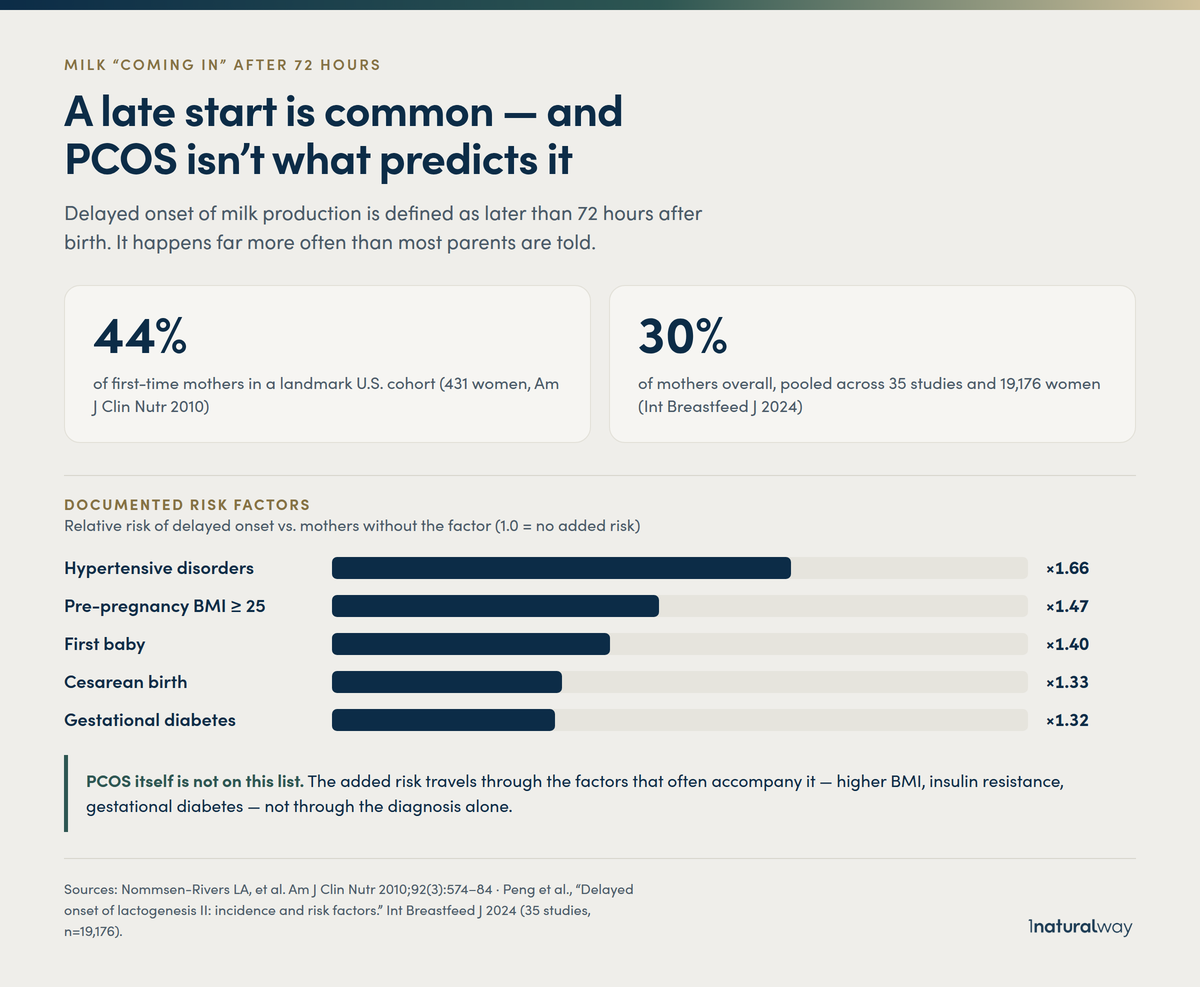
Why does this matter? Because a late start with a plan is very different from a late start with a panic. If your milk is not in by day three, that puts you with nearly half of first-time mothers — it is a reason to feed frequently and express when your baby receives supplemental breast milk or formula and to have your baby's output monitored, not evidence that your body has failed.
Sources: Nommsen-Rivers et al., Am J Clin Nutr 2010;92(3):574–84 · Peng et al., Int Breastfeed J 2024.
The Insulin Connection
If there is a real biological thread between PCOS and milk supply, the research increasingly points at insulin. A 2016 review in Advances in Nutrition put it plainly: insulin is now considered to play a direct role in lactation, including essential roles in the differentiation and activation of milk-making tissue and in mature milk production.
That fits the clinical data. In a breastfeeding-medicine clinic study, women with low milk supply were about 2.4 times more likely to have had diabetes in pregnancy than women whose problems were latch-related. And in a study of women with PCOS, those whose breasts did not grow during pregnancy — a possible sign of less glandular development — were more insulin-resistant, and breastfed for a shorter time.
The practical takeaway is not a lab panel to fear. It is that managing blood sugar in pregnancy, with your own clinicians, is also lactation preparation — and that if supply problems do appear, "how has your metabolic health been?" is one of the first questions a good lactation consultant will explore with your provider.
Sources: Nommsen-Rivers, Adv Nutr 2016;7(2):407–14 · Riddle & Nommsen-Rivers, Breastfeed Med 2016;11(2):80–5 · Vanky et al., BJOG 2012;119(11):1403–9.
A Word About Metformin
Many women with PCOS take metformin, and two separate questions get tangled together: can I keep taking it while breastfeeding, and will it help my supply?
On the first: the NIH's LactMed database reports that breastfed infants receive less than 0.5% of the mother's weight-adjusted dose — a level that falls well below the safety thresholds used in lactation medicine — and a prospective study of 111 infants found no adverse effects. LactMed does advise caution when nursing newborn or premature infants or those with kidney impairment — which is exactly the kind of case-by-case call to make with your own provider. For an expert second opinion, our clinical team suggests calling the InfantRisk Center, the research-based medication helpline for pregnant and nursing mothers, and bringing that conversation to your own provider — medication guidance circulating in practice is often out of date.
On the second, the honest answer is no — not as far as anyone has shown. LactMed states there is no evidence metformin is effective as a milk-supply booster, and the only randomized trial to test it found no significant improvement. Keep taking it if your clinician prescribes it for your metabolic health. Just do not let anyone sell it to you as a supply treatment.
Sources: LactMed, "Metformin," NIH Bookshelf NBK501020 (record revised July 2026) · Nommsen-Rivers et al., J Hum Lact 2019;35(2):261–71.
What Actually Moves the Needle
Strip away the supplements and the speculation, and what is left is a short list with real evidence behind it.
Frequent, thorough milk removal — from day one
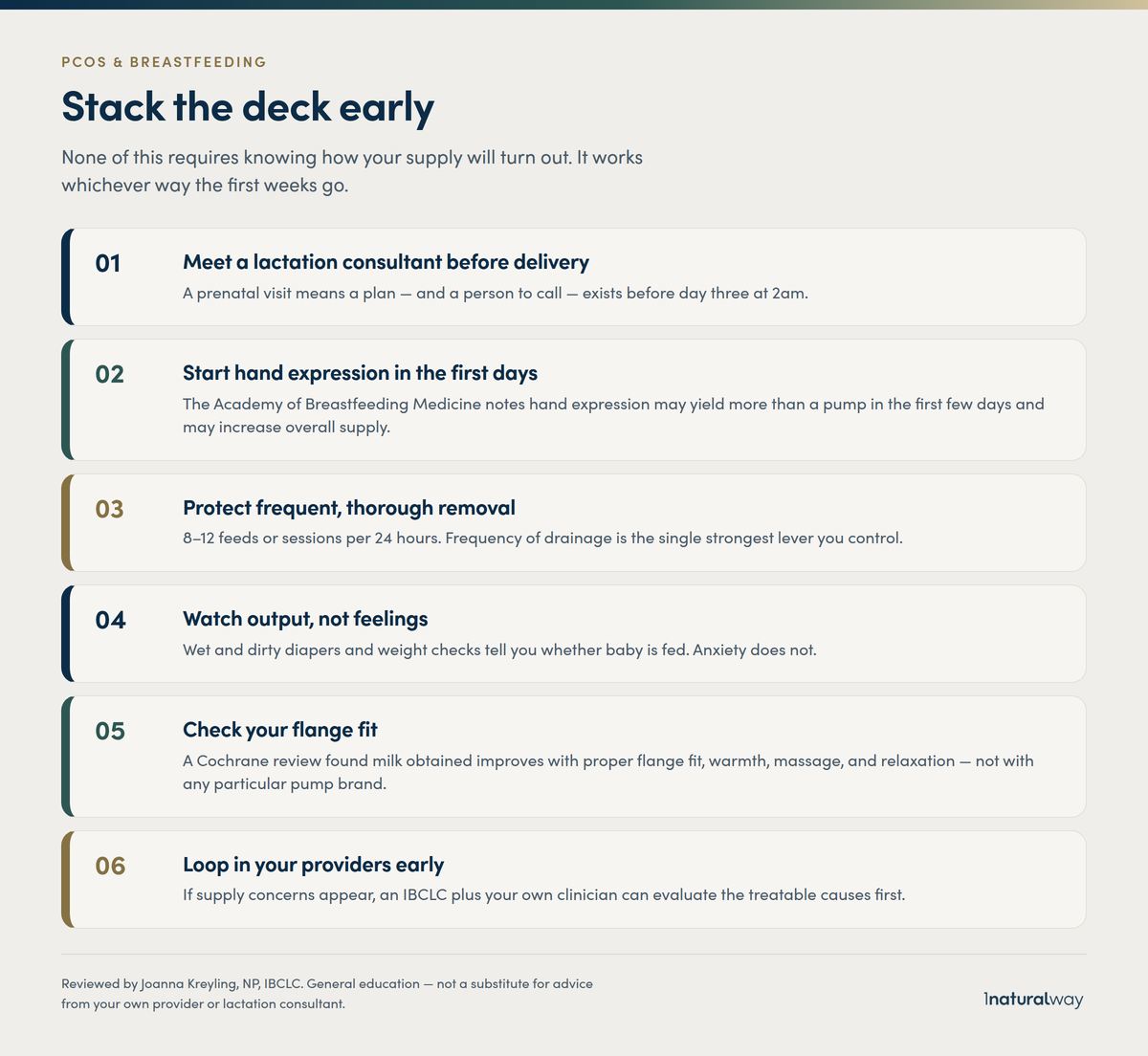
The Academy of Breastfeeding Medicine is blunt about this in its galactogogue protocol: nothing increases supply if the breast is not being drained often and well. Eight to twelve removals per 24 hours in the early weeks is the foundation everything else sits on. Pair it with as much skin-to-skin contact as possible while your baby is awake — it supports latching, let-down, milk flow, and volume.
Hand expression in the first days
The ABM notes that hand expression may yield more than a pump in the first few days after birth and may increase overall supply. It costs nothing and no equipment can replace it in those first days — ask a nurse or lactation consultant to show you before you leave the hospital. And know that hand expression takes practice — do not be discouraged if you see only drops at first. That is normal, and it improves.
Skilled support, early
A Cochrane review covering more than 74,000 mother–infant pairs found that structured breastfeeding support measurably reduces the chance of stopping early — and face-to-face, scheduled, ongoing support works best. Many insurance plans cover lactation consultations, and our guide to how a lactation consultant can help explains what a session involves. If supply does become a genuine concern, the top factors that can decrease milk supply covers the treatable causes worth ruling out first.
The right pump, fitted right
The same Cochrane evidence found no pump brand consistently outperforms another — what matters is frequency, comfort, relaxation, warmth, and correct flange fit. If you will be pumping to establish or protect supply, a double electric pump through your insurance is the practical starting point; our guide to pumps for moms with low milk supply covers the features that genuinely matter.
Check what your insurance plan covers
Watching the Early Days Without Panicking
Whether or not PCOS turns out to matter for your supply, the early monitoring is the same — and it is objective, which is a gift when you are anxious.
- Expect 8–12 feeds per 24 hours, and expect them to be irregular.
- By day 5 to 7, look for 6 or more wet diapers a day and at least 3 to 4 yellow, seedy stools.
- Weight loss up to 8–10% of birth weight can occur; the ABM is explicit that 10% is not an automatic trigger for formula — it is a trigger for an evaluation.
- If supplementation is medically indicated, the volumes are tiny — roughly 2 to 10 mL per feed in the first 24 hours — and your own expressed milk is the first choice.
That last point deserves a sentence of its own: needing to supplement is not the end of breastfeeding. Done with guidance, it is a bridge that protects your baby while your supply is established — and combination feeding is a legitimate destination in its own right, not a failure state.
Sources: ABM Clinical Protocol #3 (Revised 2017) · AAP/HealthyChildren, "How to Tell if Your Breastfed Baby is Getting Enough Milk."
When to Reach Out
Call your pediatrician, a lactation consultant, or both if:
- Your milk has not come in by day 5, or your breasts never feel fuller.
- Diaper counts are below the day-5-to-7 benchmarks above, or urine is dark after day 5.
- Feeding is painful — pain is information, not a toll to pay.
- Your baby is under birth weight at two weeks.
- You are dreading feeds, or the anxiety is not lifting. That counts as a reason.
Frequently Asked Questions
Does PCOS always cause low milk supply?
No. The belief that PCOS causes low supply traces largely to a three-mother case report from 2000, and the follow-up research is limited and mixed. The largest community study found no relationship between PCOS and breastfeeding once body mass index was accounted for. Some women with PCOS do experience real supply difficulties — but the diagnosis itself is not a prediction.
Is PCOS a risk factor for milk coming in late?
Not directly, based on current evidence. Delayed onset of milk production — later than 72 hours — affected 44% of first-time mothers in a landmark U.S. study, and the documented risk factors are first birth, cesarean delivery, BMI of 25 or higher, gestational diabetes, and hypertensive disorders. PCOS does not appear on that list; the risk appears to travel through the metabolic factors that often accompany it.
Can I take metformin while breastfeeding?
Generally yes, with your provider's guidance. The NIH's LactMed database reports that breastfed infants receive less than 0.5% of the mother's weight-adjusted dose and that a study of 111 infants found no adverse effects — a level well below the safety thresholds used in lactation medicine — with extra caution advised for newborn, premature, or kidney-impaired infants.
Will metformin increase my milk supply?
There is no evidence that it does. LactMed states this directly, and the only randomized trial of metformin for low milk supply found no significant improvement. Take it if it is prescribed for your metabolic health — but it is not a supply treatment.
Do herbal supplements like fenugreek help with PCOS-related supply issues?
The Academy of Breastfeeding Medicine's galactogogue protocol says it cannot recommend any specific galactogogue, herbal or pharmaceutical, and that nothing increases supply if milk removal is infrequent or incomplete. Address drainage, latch, and flange fit first — with skilled support — before spending money on supplements.
What should I do during pregnancy to prepare?
Three things with real evidence behind them: work with your providers on blood-sugar management, since insulin plays a direct role in lactation; arrange a prenatal visit with a lactation consultant so a plan exists before delivery; and learn hand expression, which the ABM notes may yield more than a pump in the first days after birth.
Is combination feeding a failure?
No. If supplementation is medically needed, the volumes are small, your own expressed milk is the first choice, and it is a bridge that protects your baby while supply is established. Many families also choose combination feeding deliberately and continue it long-term. A fed, thriving baby and a supported mother is the outcome that matters.
Is a breast pump covered by insurance?
Under the Affordable Care Act, most health plans are required to cover a breast pump. Coverage varies by plan — some pumps are covered in full, while premium models may involve an out-of-pocket upgrade cost. Submit your insurance information and we'll review your coverage. For plan-specific benefit limitations and restrictions, contact your insurance for details.
Your Diagnosis Is Not a Prediction
If you take one thing from this article, make it that sentence. The bleak version of the PCOS-and-breastfeeding story is built on less evidence than almost anyone admits, and the things that genuinely change outcomes — early skilled support, frequent removal, honest monitoring — are available to you regardless of how your supply story turns out.
If we can help with a pump, replacement parts, or lactation support through your insurance, we are here — or call (888) 977-2229 and talk to a real person about your options.