
There are two versions of illness season with a baby. In one, the first fever arrives and you are googling medication safety at 3am with a congested newborn on your chest. In the other, you made your decisions early - the vaccines are scheduled, the medicine cabinet is sorted, the pump parts are clean and backed up - and the same fever is just a hard week.
This article is for building the second version. The CDC puts RSV season's start between mid-September and November in most of the country, which means the season has opened - but the winter peak is still ahead, and this week is the right moment to lock in your plan. For what to do in the moment you are actually sick, our guide to breastfeeding with a cold covers it - and if fall has already scrambled your routine, the fall routine reset is the companion piece to this one.
Why RSV Gets Its Own Planning
Colds are a certainty and flu is a threat, but RSV is the one that changes infant planning. Most children get RSV by age two, and it is the leading cause of hospitalization in U.S. infants - an estimated 58,000 to 80,000 children under five were hospitalized each year before the new immunizations arrived. The AAP puts the individual risk plainly: two to three of every 100 infants with RSV may need a hospital stay.
One more thing worth knowing: in very young infants, RSV may not look like a cold at all. The CDC notes their only symptoms may be irritability, decreased activity, and breathing difficulty - which is why the warning signs section later in this article matters more than symptom-spotting.
Sources: CDC, "RSV in Infants and Young Children" (cdc.gov/rsv, updated Feb 2026) · CDC, "Surveillance of RSV" · AAP/HealthyChildren, "RSV: When It's More Than Just a Cold."
The 2026-27 Protection Calendar
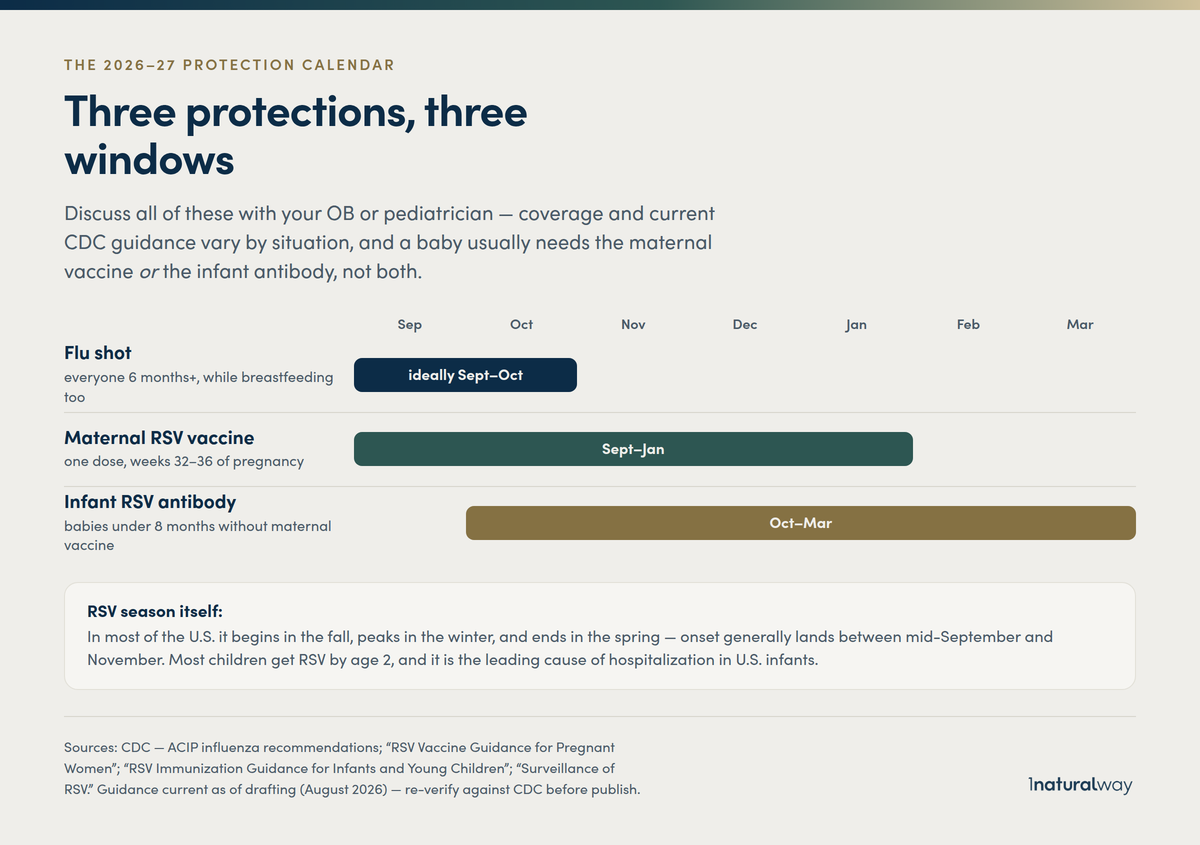
Three protections, three windows - and every one of them is a conversation with your own OB or pediatrician, because eligibility and current guidance vary by situation.
Flu - while pregnant or breastfeeding
The standing recommendation is annual flu vaccination for everyone 6 months and older, ideally in September or October. The CDC is specific on the breastfeeding question: vaccination while pregnant or breastfeeding produces antibodies that are shared with your baby through breast milk - protection for an infant who is too young for their own flu shot in the earliest months. And if October slipped past you, it is not too late: the CDC advises continuing vaccination for as long as flu viruses are circulating, which runs deep into winter.
RSV - one protection per baby, usually not both
Babies can be protected against RSV one of two ways: a maternal RSV vaccine given between weeks 32 and 36 of pregnancy, September through January in most of the country - or an antibody immunization given directly to the baby, October through March, for infants under 8 months whose mothers did not receive the maternal vaccine. The CDC is explicit that most babies do not need both. Which route fits your family is exactly the conversation to have with your OB and pediatrician this month.
COVID - now an individual decision
Guidance here changed recently, and it is worth knowing so old articles do not mislead you: COVID-19 vaccination during pregnancy and breastfeeding is no longer a blanket recommendation. Current CDC guidance calls for an individual risk-benefit conversation with your healthcare provider rather than a one-size-fits-all answer. This guidance has been a moving target over the past two seasons, so fold the question into the same provider visit where you discuss flu and RSV - your OB and pediatrician, not any article, are the current source here.
Sources: CDC - ACIP influenza recommendations (flu.gov/hcp pages) · "RSV Vaccine Guidance for Pregnant Women" · "RSV Immunization Guidance for Infants and Young Children" · "COVID-19 Vaccination for Women Who Are Pregnant or Breastfeeding" and CDC clinical considerations for special populations (reviewed Oct 2026). All guidance re-verified against live CDC pages October 19, 2026.
Clinical Insight from Joanna Kreyling, NP, IBCLC: "The question I get most in October is some version of 'is it safe to keep nursing while I am this sick?' - and the answer is almost always that continuing is exactly what protects the baby. Your milk carries the antibodies your body is making against the very virus in your house. The planning conversation I wish more families had early is the RSV one: maternal vaccine or infant antibody, decided calmly with your providers, instead of in a November scramble."
If You Get Sick: Feed Through It
The short version, consistent across CDC guidance: for nearly all common winter illnesses, keep breastfeeding. Even with the flu, breast milk remains the recommended source of nutrition for your infant, and it carries antibodies your body is actively making. Wash your hands thoroughly before touching your baby, consider a mask during close contact while symptomatic, and if you are too sick to nurse directly, express milk on your normal schedule and let a healthy adult feed it.
And a permission slip from our clinical team, worth taping to the door this season: It is okay to tell others no when they ask to hold your baby, and okay to ask before a gathering whether anyone is getting over a cold. This is your baby - you decide what is best for them, and you are the one who will be up all night caring for a sick infant, not the person asking. If you do welcome close contact, be diligent about handwashing or hand sanitizer, and encourage family members to stay current on their own vaccinations.
The practical details - positioning with a congested baby, protecting supply through a rough week - live in our breastfeeding-with-a-cold guide. What that guide does not cover is the medicine cabinet, so:
The Medicine Cabinet, Sorted in Advance
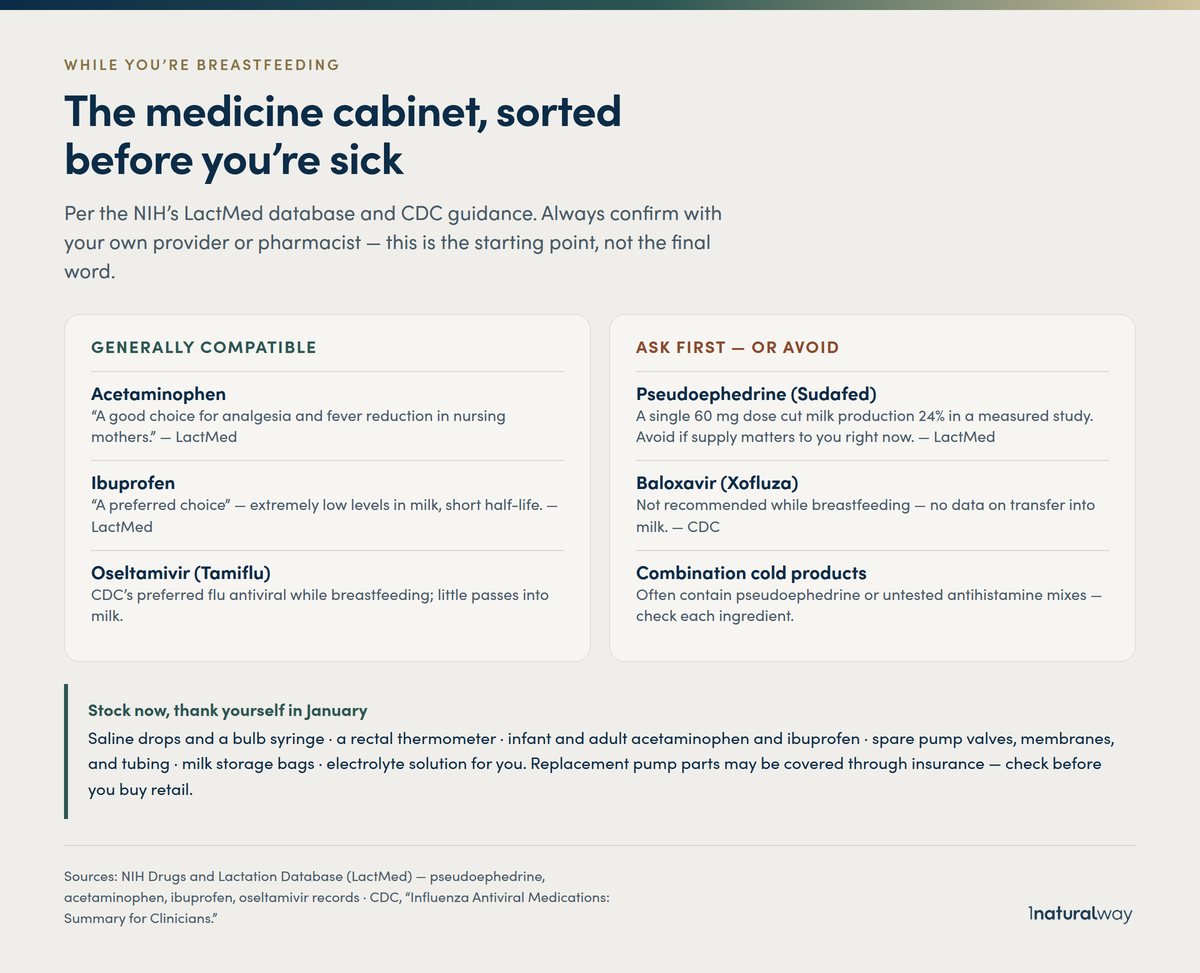
Three things are worth knowing before you are standing in a pharmacy aisle with a fever.
- The safe defaults are genuinely safe. LactMed - the NIH's drugs-and-lactation database - calls acetaminophen "a good choice" and ibuprofen "a preferred choice" for nursing mothers, with milk levels far below infant doses.
- The decongestant is the trap. A single 60 mg dose of pseudoephedrine reduced milk production by 24% in a measured study, and LactMed advises mothers to avoid it when supply matters. It also hides inside most combination cold products - check every ingredient, or ask the pharmacist to.
- Flu antivirals have a clear pecking order. The CDC's preferred antiviral while breastfeeding is oseltamivir (Tamiflu), which passes only minimally into milk. Baloxavir (Xofluza) is not recommended - there is simply no data on it in breastfeeding.
None of this replaces your own provider or pharmacist - medication decisions while breastfeeding are individual. But walking in knowing the landscape makes that conversation five minutes instead of a spiral.
Sources: LactMed (NIH): pseudoephedrine (NBK501085, rev. Apr 2026), acetaminophen, ibuprofen, oseltamivir records · CDC, "Influenza Antiviral Medications: Summary for Clinicians" (updated Mar 2026).
Pump Hygiene: The Once-a-Season Reset
Illness season is when pump hygiene stops being theoretical. The CDC's current guidance, condensed:
- Wash hands for 20 seconds before handling pump parts.
- After every session, rinse milk-contact parts, then wash them in a dedicated basin with soap and warm water - or the dishwasher - and air-dry fully on a clean towel.
- Sanitize parts at least once daily (steam bag, 5-minute boil, or dishwasher sanitize cycle) - especially important if your baby is under 2 months, premature, or immunocompromised.
- Moldy tubing is not cleanable. Discard and replace immediately, along with any part that is cracked, warped, or worn.
That last point is the one to act on today: inspect your valves, membranes, and tubing now, and keep spares. Worn parts quietly cost suction before they visibly fail - our guide on how often to replace pump parts covers the manufacturer intervals, and replacement parts may be covered through your insurance. Check what your plan includes before you buy retail; our Milkzoom replacement-parts program makes restocking easy - we send email and text reminders when you are due for fresh parts, and you place the order in a couple of clicks.
Source: CDC, "How to Clean and Sanitize Breast Pumps" (updated Sept 2024).
When It's More Than a Cold: The Short List
Memorize four things, and let everything else be a daytime phone call:
- Fever in a young baby: a rectal temperature of 100.4°F (38°C) or higher in a baby under 3 months means call the pediatrician immediately - day or night.
- Working to breathe: fast breathing with nostrils flaring or head bobbing, skin tugging between the ribs or at the base of the neck with each breath, grunting, or pauses in breathing. Emergency care, now.
- Color change: pale, gray, or blue-tinged skin, lips, or nail beds. Emergency care, now.
- Dehydration: wet diapers dropping off, dark urine, a dry mouth, or little to no drool - call the same day, and in a newborn do not wait hours to count diapers before calling.
And a feeding-specific note for congested babies: suction the nose with saline and a bulb before feeds, and expect feeding patterns to change - often shorter, more frequent feeds, because a congested baby tires quickly working to breathe and eat at the same time. Upright nursing positions, like a koala hold or laid-back nursing, are kinder to a stuffy nose than lying flat, and hydration matters more than schedule. If latching is impossible mid-illness, expressed milk by cup or bottle keeps your baby fed and keeps telling your body to make milk.
Sources: AAP/HealthyChildren - "Fever and Your Baby," "RSV: When It's More Than Just a Cold" (incl. feeding guidance) · CDC, "Symptoms and Care of RSV."
The Stock-Up (Do It This Week)
One shopping trip, one shelf, before anyone is sick: saline drops and a bulb syringe, a rectal thermometer, infant and adult acetaminophen and ibuprofen, spare pump valves, membranes and tubing, milk storage bags, and an electrolyte drink for you. Add the phone numbers - pediatrician, nurse line, lactation consultant - taped inside the cabinet door, because 3am is not when you want to be searching for them.
Frequently Asked Questions
Should I keep breastfeeding if I have a cold or the flu?
Yes, in nearly all cases. The CDC states that even with the flu, breast milk remains the recommended source of nutrition for your infant - and it carries the antibodies your body is making against the illness. Wash hands before handling your baby, consider a mask during close contact while symptomatic, and if you are too sick to nurse, express milk on your usual schedule and have a healthy adult feed it.
What cold medicine is safe while breastfeeding?
Acetaminophen and ibuprofen are the well-established defaults - the NIH's LactMed database calls them good and preferred choices for nursing mothers. The one to watch is pseudoephedrine: a single 60 mg dose reduced milk production by 24% in a measured study, and it hides in most combination cold products. Always confirm with your own provider or pharmacist.
Can I take Tamiflu while breastfeeding?
Yes - oseltamivir (Tamiflu) is the CDC's preferred flu antiviral for breastfeeding mothers, and only minimal amounts pass into milk. Baloxavir (Xofluza) is not recommended while breastfeeding because there is no data on its transfer into milk.
Does my baby need the RSV shot if I got the RSV vaccine during pregnancy?
Usually not - the CDC states most babies do not need both. Babies are protected either by the maternal RSV vaccine given at weeks 32 to 36 of pregnancy, or by an antibody immunization given directly to infants under 8 months entering their first RSV season. Your pediatrician can confirm which applies to your baby.
How dangerous is RSV for babies, really?
For most children it behaves like a cold, and most get it by age two. But it is the leading cause of hospitalization in U.S. infants, and the AAP estimates two to three of every 100 infants with RSV may need a hospital stay. Very young babies may show only irritability, decreased activity, and breathing difficulty rather than cold symptoms - which is why the breathing and hydration warning signs matter more than symptom-watching.
How often should I sanitize pump parts?
Per current CDC guidance: wash milk-contact parts after every use, and sanitize at least once daily - by steam bag, a five-minute boil, or a dishwasher sanitize cycle. Daily sanitizing matters most if your baby is under 2 months old, premature, or immunocompromised. Moldy tubing cannot be cleaned and should be replaced immediately.
Can I get a flu shot while breastfeeding?
Yes. The CDC recommends annual flu vaccination for everyone 6 months and older, ideally in September or October, and notes that vaccination while pregnant or breastfeeding produces antibodies that reach your baby through breast milk. If October has passed, it is still worth getting - the CDC advises continuing vaccination as long as flu viruses are circulating.
Are replacement pump parts covered by insurance?
Often, yes - many plans cover replacement parts on a regular schedule, though coverage varies by plan. Submit your insurance information and we'll review your coverage. For plan-specific benefit limitations and restrictions, contact your insurance for details.
Build the Plan While Everyone Is Healthy
Illness season with a baby is not avoidable. The 3am scramble mostly is. An hour this month - vaccines discussed, cabinet stocked, pump parts inspected, numbers taped to the door - buys you a winter where sick weeks are just hard, instead of hard and chaotic.
If the pump-parts half of that checklist is yours to do, we can help: check your replacement-parts coverage, or call (888) 977-2229 and a real person will sort it with you.